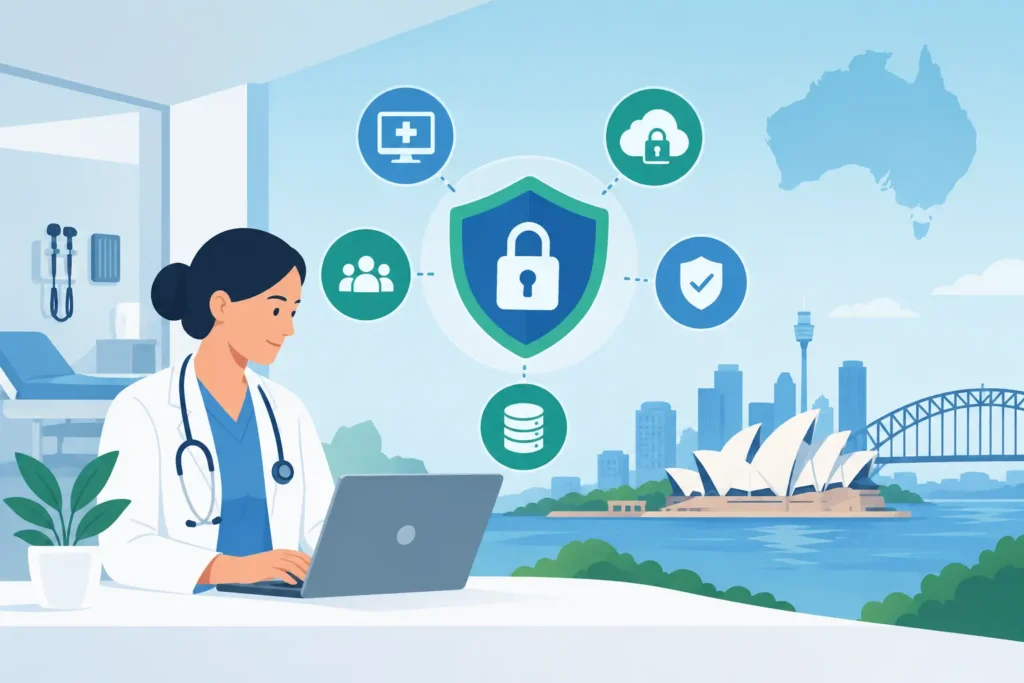
Healthcare Cybersecurity Trends for Australian Clinics
A single compromised staff login can stop an allied health practice from accessing its booking calendar, clinical notes, invoices and patient communications. For NDIS providers, the consequences can extend further, disrupting participant support and creating difficult privacy obligations. Healthcare cybersecurity trends are therefore no longer a concern reserved for large hospitals. They are an operational priority for every Australian healthcare business that handles sensitive information.
For practice owners and operations leaders, the goal is not to turn your team into cybersecurity specialists. It is to build sensible controls around the way work is already done: booking appointments, processing referrals, updating records, managing rosters and communicating with patients. The right approach protects continuity of care while giving clinicians more time to treat patients.
Healthcare cybersecurity trends shaping practice operations
Identity security is replacing the password-only approach
Stolen credentials remain one of the simplest ways for attackers to enter a healthcare system. A receptionist may receive an email that appears to come from a software provider. An accounts team member may be asked to urgently update bank details. A clinician may reuse a password that has been exposed in a separate breach. None of these situations requires an advanced technical attack.
This is why multi-factor authentication is becoming a baseline expectation rather than an optional extra. It adds a second verification step when a user signs in, reducing the value of a stolen password. Practices should also give each staff member their own account rather than sharing a generic reception or admin login. Individual accounts create accountability and make it far easier to remove access when someone changes roles or leaves.
The trade-off is a small amount of additional friction at sign-in. For most practices, that inconvenience is minor compared with the disruption of a compromised practice management system. Set up authentication methods that staff can use reliably, document the process, and ensure there is a secure recovery method if a mobile is lost.
Remote and offshore teams need deliberate access controls
Flexible work is now embedded in healthcare administration. Virtual assistants, remote receptionists and distributed management teams can reduce local staffing costs, extend administrative coverage and help practices respond to growing waitlists. But location does not determine security – process does.
The key trend is least-privilege access. Each person should be able to access the systems and information required for their role, and nothing more. A team member who manages appointment reminders may need calendar and messaging access, for example, but not full visibility of financial reporting or clinical records beyond what their task requires.
Access should be reviewed when responsibilities change, not only during an annual audit. This includes removing former staff promptly, reviewing shared inbox permissions, and checking who can download reports or export patient data. A healthcare-trained offshore team should operate within the same documented access, confidentiality and escalation rules as an onshore employee.
For Australian healthcare businesses, vendor due diligence matters here. Ask staffing and technology partners how they screen personnel, manage devices, monitor access, handle confidentiality and respond to security incidents. Cost savings are valuable, but they should never come at the expense of patient privacy or control over your data.
Ransomware planning is becoming a continuity issue
Ransomware is not simply an IT problem. When systems are unavailable, clinicians cannot easily confirm appointments, retrieve treatment histories or send referrals. Teams may resort to manual workarounds, which can create further privacy and documentation risks during an already stressful period.
The practical response is to plan for recovery before an incident occurs. Regular backups should be protected from the main network and tested to confirm they can actually be restored. Your practice also needs a clear, short incident response plan: who contacts your IT provider, who communicates with staff, how patient appointments are managed, and when legal or privacy advice is required.
A printed or securely stored downtime procedure is worth having. It should cover the essentials, including how to verify upcoming appointments, record urgent clinical information, and communicate changes with patients. The most effective plan is not the longest document. It is the one your team can follow at 8 am on a busy Monday when the system is unavailable.
Third-party software is under closer scrutiny
Healthcare practices now rely on a broad stack of platforms: practice management software, telehealth tools, accounting packages, online forms, email, payment systems and marketing applications. Every connection can improve efficiency, but each one also creates another point to assess.
Before adding a new platform, confirm what patient information it collects, where data is stored, who can access it and whether you can control user permissions. Consider whether the tool is essential or merely convenient. A low-cost application that stores sensitive client details without adequate safeguards can create a disproportionate risk.
This does not mean avoiding useful technology. It means choosing tools that fit your operating model and putting ownership around them. Maintain a simple register of the systems your practice uses, the person responsible for each system, and the staff who have administrator access. This makes vendor reviews, staff changes and incident response far more manageable.
AI use requires clear boundaries, not blanket bans
AI tools are increasingly used to draft emails, summarise meetings, create marketing content and assist with administration. Used carefully, they can cut admin time and help small teams work faster. Used carelessly, they can expose patient information or generate inaccurate content that is treated as fact.
The sensible approach is to set clear rules. Staff should not enter identifiable patient or participant information into unapproved public AI tools. Any AI-generated communication should be reviewed by a trained person before it is sent. Clinical judgement, documentation standards and patient communication remain human responsibilities.
There is also a productivity consideration. A complete ban may encourage staff to use tools informally without guidance. A practical policy identifies approved uses, restricted information, review requirements and the person who can approve a new tool. It gives your team direction without slowing down legitimate improvements.
Where most practices should focus first
Cybersecurity improvements do not need to begin with an expensive technology overhaul. Start with the controls that reduce common and avoidable risks across your whole operation.
First, turn on multi-factor authentication for email, practice management systems, cloud storage and finance platforms. Email should be a priority because it is often the gateway to password resets, invoices and sensitive conversations.
Second, review user access. Remove inactive accounts, stop sharing passwords, restrict administrator privileges and make access removal part of every offboarding checklist. If you use virtual staff, make sure their onboarding and offboarding process is documented and followed consistently.
Third, train for real-world risks. Short, regular training on suspicious emails, payment changes, unexpected attachments and patient privacy is more effective than an annual compliance exercise that staff quickly forget. Encourage people to report uncertainty early. A questioned email is far less costly than a clicked malicious link.
Finally, test your backup and downtime arrangements. Ask a simple question: if our key system were unavailable tomorrow morning, how would we keep patients informed and continue care safely? The answer will reveal gaps that a policy document alone may not show.
Security supports capacity, confidence and growth
The most useful healthcare cybersecurity trends are not about chasing every new threat headline. They are about building consistent habits that let your practice operate with confidence as it adopts new systems, adds sites or expands its team.
For allied health and NDIS organisations, this is directly connected to growth. Clear access controls allow administrative work to be delegated safely. Reliable processes reduce the risk that clinicians are pulled into avoidable admin issues. Well-managed remote teams can improve responsiveness without compromising confidentiality.
HealthDoers supports this model by providing healthcare-trained virtual staff who can work within defined workflows, confidentiality requirements and access controls. The strongest result comes when the staffing partner, practice leadership and technology provider all treat security as part of everyday service delivery.
Start with one operational question: who can access your patient information, why do they need it, and what happens if that access is misused or unavailable? Answer it clearly, then build the next improvement from there.
You might also like
-
Uncategorized

Support Coordination Admin Example That Saves Time
See a practical support coordination admin example, including tasks, workflows and controls that reduce admin load while protecting participant service.
-
Uncategorized
NDIS Administration Software That Saves Time
Choose NDIS administration software that reduces manual work, protects participant information and gives your team more time for quality support daily.
-
Uncategorized
Do Remote Staff Process Referrals? Yes, Safely
Do remote staff process referrals? Learn which referral tasks healthcare VAs can manage, how practices protect privacy, and where clinicians stay involved.