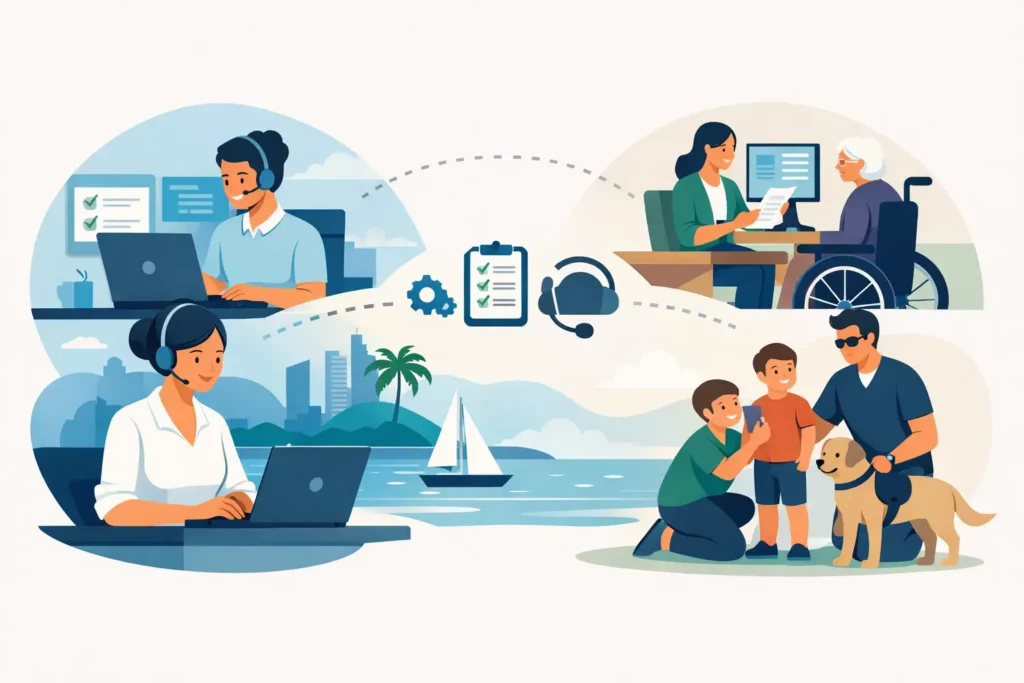
Offshore Admin Support for NDIS Providers
An NDIS provider can have a full diary, a growing waitlist and capable clinicians on staff, yet still lose capacity every day to paperwork, bookings, billing and follow-up. That is where offshore admin support for NDIS providers becomes a practical operational decision, not just a staffing shortcut. When the right work is delegated to healthcare-trained offshore staff, providers can cut admin time, reduce staffing costs and free local teams to focus on participants.
Why admin pressure slows NDIS growth
Most NDIS businesses do not hit a growth ceiling because demand disappears. They hit it because back-office work expands faster than the team can handle. Intake calls pile up, service agreements sit in drafts, rosters need constant changes, invoices are delayed and clinicians end up doing tasks that do not require clinical judgement.
That creates a costly pattern. Senior staff spend time chasing referrals, confirming appointments and managing inboxes. Practice managers become the bottleneck for every small process issue. Directors step back into administration just to keep things moving. Over time, participant experience can suffer through slower response times, more scheduling friction and delayed documentation.
For many providers, local admin hiring is not a simple fix. Wages are higher, recruitment takes time and turnover can reset the whole process. If you need support now, waiting months to recruit and train a new local administrator may not match the urgency of your operational needs.
What offshore admin support for NDIS providers actually covers
The phrase can mean very different things depending on the staffing model. Generic offshore admin support usually gives you a generalist who still needs to learn healthcare language, local workflows and the sensitivities of participant communication. That often creates more supervision than expected.
Healthcare-specific offshore admin support is different. In a well-structured model, offshore staff are trained in Australian healthcare and NDIS workflows and work as an embedded extension of your team. They can support appointment scheduling, participant enquiries, service agreement preparation, inbox management, CRM or PMS updates, billing support, data entry, report formatting, document follow-up and general coordination tasks.
The key is not whether a task is done offshore or onshore. The key is whether the task is process-driven, clearly defined and appropriate to delegate. Admin that follows rules, timeframes and repeatable workflows is usually a strong fit. Work that depends on complex clinical decisions, sensitive escalation or high-level relationship management may still be better kept with local senior staff.
The real commercial case for offshore support
Cost reduction gets attention, and rightly so. Many providers explore offshore staffing because local labour costs keep rising while NDIS pricing pressure remains real. Reducing staffing costs by up to 70% can materially change margins.
But the stronger business case is usually capacity. If offshore support takes bookings, admin follow-up, billing preparation and routine coordination off your clinicians and local admin team, you create more room for billable work. Clinicians can see more participants. Managers can focus on oversight instead of task chasing. Response times improve, and that can support both retention and referrals.
There is also a speed advantage. A provider with urgent operational pressure often needs help in weeks, not quarters. A specialist partner can place trained support faster than a traditional hiring cycle, which matters when your current team is already stretched.
Where providers get it wrong
Offshore admin can work very well, but it is not set-and-forget. The biggest mistakes usually come from poor role design rather than the location of the staff member.
One common issue is trying to hand over everything at once. If your processes are undocumented, your systems are inconsistent and no one owns onboarding, an offshore team member will struggle for the same reason a local hire would. Another issue is assigning work that changes constantly without clear approval pathways. That creates delays, confusion and avoidable rework.
Compliance is another line in the sand. NDIS providers deal with participant information, sensitive records and operational obligations that cannot be treated casually. If a staffing provider cannot explain its security controls, confidentiality measures, training standards and monitoring approach in plain terms, that is a warning sign.
What to look for in an offshore staffing partner
If you are assessing offshore admin support for NDIS providers, healthcare experience should be non-negotiable. General business admin experience is not enough. Your support team needs to understand participant-facing communication, healthcare terminology, scheduling logic, funding-related administration and the pace of a clinical environment.
Compliance and security should be visible, not implied. Ask how staff are screened, how access is controlled, what cyber-security measures are in place and how performance is monitored. The right provider will be comfortable answering those questions because they are built into the model.
Operational fit matters just as much. You want staff who can work inside your existing systems and processes, not force you to rebuild everything around them. Good offshore support should feel like an extension of your practice, with clear shift coverage, reporting, communication channels and accountability.
This is where a specialist healthcare workforce partner stands apart from a general outsourcing firm. A provider such as HealthDoers Australia focuses on healthcare-trained offshore staff who are pre-vetted, compliance-aligned and ready to integrate into allied health and NDIS workflows. That reduces ramp-up time and lowers the risk that your local team spends weeks training someone from scratch.
Which NDIS tasks are best to delegate first
The best starting point is usually the work that is repetitive, time-sensitive and easy to measure. Appointment confirmations, intake administration, inbox triage, data entry, basic billing support and document management are often immediate wins. These tasks consume a surprising amount of local time, yet they usually follow clear rules.
Once the team member is settled, many providers expand the role into participant onboarding support, service agreement preparation, roster coordination and internal follow-up. The progression should be deliberate. Start with tasks that reduce admin pressure quickly, then add complexity as trust and process maturity improve.
This staged approach matters because it lets you see measurable results early. You can track reduced turnaround times, fewer missed follow-ups, better diary utilisation and less clinician time spent on admin. Those are practical gains, not abstract efficiency claims.
How to make offshore admin support work inside your business
Successful implementation usually comes down to three things: role clarity, workflow discipline and active management. The role should have a defined task list, expected turnaround times and clear escalation rules. Your systems should be documented enough that another team member can follow them without relying on memory or guesswork.
Management does not need to be heavy-handed, but it does need to be real. Offshore staff perform best when they have direct communication with the local team, regular feedback and visibility over priorities. A structured portal or reporting framework can help managers track shifts, workloads, compliance and performance without micromanaging.
It also helps to treat offshore staff as part of the team rather than a background service. When they understand your participant journey, service model and internal standards, the quality of support improves. Integration drives outcomes.
Is offshore support right for every NDIS provider?
Not always. If your operation is very small, your processes change daily and the work depends heavily on one person’s judgement, you may need to tidy up your systems before bringing in offshore support. Likewise, if you expect a new team member to solve deep internal process problems without leadership involvement, the result may disappoint.
However, for many growing NDIS providers, especially those dealing with admin overload, rising labour costs and clinician capacity constraints, offshore admin support is a practical way to scale. It is not about replacing the local team. It is about making sure local expertise is used where it adds the most value.
The strongest results usually come when providers stop thinking of admin as unavoidable overflow and start treating it as a function that can be designed properly. Once that shift happens, offshore support becomes less about saving money and more about building a business that can respond faster, serve more participants and grow with control.
If your clinicians are still doing work that should have been delegated months ago, that is usually the signal. The right support model does not just take tasks off the list. It gives your business room to move again.
You might also like
-
Uncategorized
Healthcare Cybersecurity Trends for Australian Clinics
Healthcare cybersecurity trends are reshaping how Australian clinics protect patient data, manage remote teams and keep care moving safely every day.
-
Uncategorized

Support Coordination Admin Example That Saves Time
See a practical support coordination admin example, including tasks, workflows and controls that reduce admin load while protecting participant service.
-
Uncategorized

NDIS Administration Software That Saves Time
Choose NDIS administration software that reduces manual work, protects participant information and gives your team more time for quality support daily.