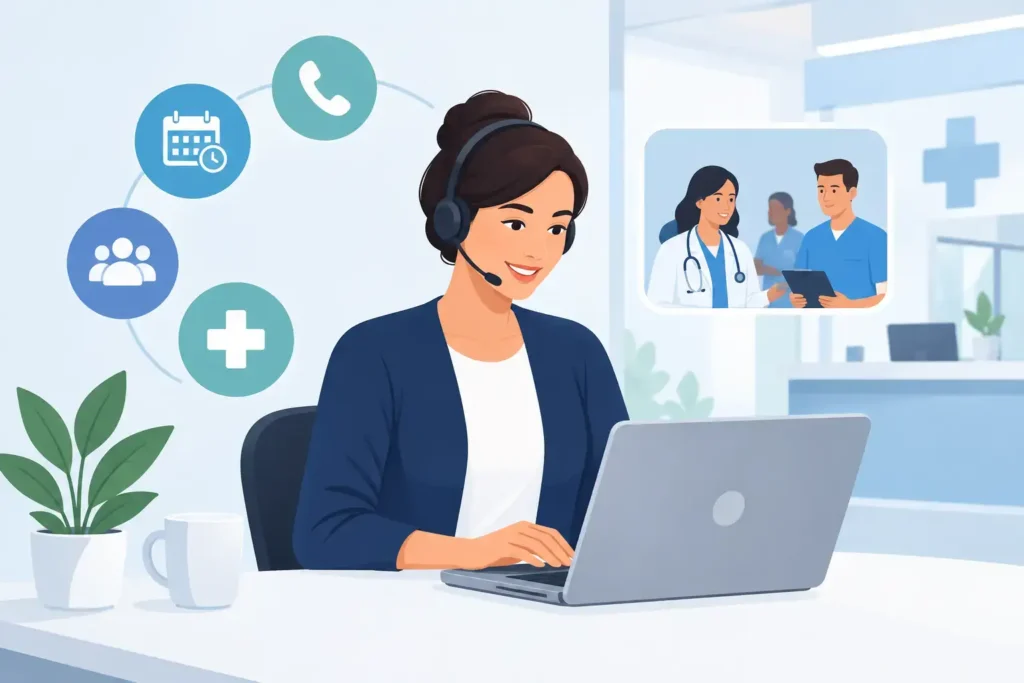
Best Remote Reception Tasks for Healthcare Teams
A ringing phone during a consultation, an unconfirmed appointment and an overdue account can each pull a clinician away from billable care. The best remote reception tasks remove that pressure without compromising the responsive, respectful experience patients expect from an Australian healthcare practice.
For allied health, community care and NDIS providers, remote reception is not simply about answering calls from another location. It is about assigning repeatable, process-led work to healthcare-trained staff who understand privacy, patient communication, practice software and the boundaries of their role. Done well, it creates more capacity for care while reducing staffing costs.
What makes a reception task suitable for remote support?
The strongest tasks are structured, high-volume and easy to track through clear systems and service standards. They should have defined escalation pathways, approved scripts where needed, and access controls that protect patient information. A trained remote receptionist can manage the workflow consistently, while clinical judgement stays with qualified practitioners.
This distinction matters. Remote team members can collect information, manage bookings and direct enquiries according to your protocols. They should not provide clinical advice, determine urgency outside an approved pathway, or make decisions that require professional registration. Clear role design protects patients, clinicians and the business.
Best remote reception tasks for Australian practices
Appointment booking, changes and waitlist management
Booking is one of the highest-value remote reception functions because delays quickly turn into lost appointments. A remote receptionist can answer booking enquiries, schedule new and existing patients, process cancellations and manage reschedules across your nominated practice management system.
Waitlist management is particularly valuable for practices with long lead times. When a cancellation appears, the receptionist can contact suitable patients in order, fill the opening and document the outcome. This improves utilisation without asking a clinician or practice manager to spend their day chasing phone calls.
The process must reflect your rules. That includes appointment types, practitioner preferences, referral requirements, cancellation policies, telehealth eligibility and escalation steps for urgent requests.
Phone answering and patient enquiry handling
Patients judge a practice before they arrive. A prompt, calm answer to a phone call can be the difference between a confirmed booking and a caller moving on. Healthcare-trained remote receptionists can answer inbound calls, provide approved general information, take accurate messages and route enquiries to the right person.
For an NDIS provider, this may include capturing participant details, understanding whether the caller is a participant, nominee, support coordinator or family member, and recording the enquiry correctly. For allied health practices, it may mean explaining referral pathways, fees or appointment availability without drifting into clinical advice.
Call handling works best when the team has scripts, a live directory and agreed response times. If a call cannot be resolved immediately, the receptionist should own the follow-up rather than leaving the patient to call again.
Appointment reminders and attendance follow-up
No-shows create a direct cost and leave patients without the support they need. Remote reception staff can send reminders by your approved channels, confirm attendance, respond to simple booking replies and follow up missed appointments according to your policy.
This task is more than sending automated messages. A receptionist can identify patients who need a call, record contact attempts and offer rebooking options. Over time, practice managers can see whether certain appointment types, days or locations require a different reminder process.
For services supporting vulnerable clients, use communication preferences carefully. Consent, contact details and confidentiality settings must be current before messages are sent.
Referral intake and administration
Referral handling often becomes a bottleneck between an initial enquiry and a first appointment. A remote receptionist can receive referrals through approved channels, check that required fields are present, enter information into the relevant system and flag incomplete documentation for follow-up.
They can also acknowledge receipt, advise referrers of standard next steps and maintain a clear referral register. The clinical team remains responsible for assessing suitability, priority and any clinical risks. Separating administration from clinical review helps referrals move faster without blurring accountability.
Billing support, accounts and payment follow-up
Remote reception can support the administrative side of revenue collection, including issuing invoices, taking payments through approved processes, sending account reminders and responding to straightforward billing questions. This is especially useful for practices where clinicians currently stay back to complete routine account work.
The right level of access depends on your systems and risk controls. Some businesses may allow a remote team member to prepare invoices and send reminders, while a local manager approves adjustments, refunds or complex funding matters. For NDIS services, billing workflows should align with your service agreements, claiming processes and documentation requirements.
Data entry, document management and record maintenance
Accurate records are essential to patient care, reporting and compliance. Remote reception staff can upload documents, update demographic details, attach correspondence, maintain contact records and prepare files for clinician review.
This work is often underestimated because each task is small. Across a busy week, however, incomplete records create failed reminders, duplicate entries, billing errors and frustrated patients. A dedicated remote administrator can keep records current while clinicians focus on notes and care delivery.
Access should always follow the principle of least privilege. Give staff the access needed for their duties, monitor activity and remove access promptly when roles change.
Tasks that need tighter controls or local escalation
Not every front-desk responsibility should be handed over in full. Clinical triage, crisis calls, safeguarding concerns, complaints involving serious risk and decisions about treatment require immediate escalation to an authorised local clinician or manager.
Physical tasks also remain on site. Receiving patients at the counter, handling paper originals, managing a waiting room and responding to a facility incident need a local team member. A hybrid reception model is often the practical answer: remote staff manage calls, bookings and back-office queues, while onsite staff cover the physical patient experience.
Build a remote reception workflow that performs
Start by mapping the tasks currently interrupting clinicians and practice managers. Look for work that is repetitive, measurable and dependent on a clear process rather than individual memory. Then document the workflow: where requests arrive, who owns each stage, what must be recorded, and when an issue is escalated.
Training should cover more than software logins. Your remote receptionist needs to understand your patient journey, service mix, terminology, communication style, funding pathways and confidentiality requirements. This is why healthcare-specific capability matters more than generic administrative experience.
Set practical service measures from day one. Track call answer rates, abandoned calls, booking conversion, time to respond to enquiries, cancellation fill rate, outstanding accounts and data-entry accuracy. Measures should improve performance, not encourage rushed interactions. A short call that leaves a patient confused is not a successful call.
HealthDoers supports Australian healthcare businesses with pre-vetted, healthcare-trained remote staff who can integrate into established workflows. With the right onboarding, access controls and performance expectations, practices can reduce staffing costs by up to 70% while protecting service quality.
Questions practice managers often ask
Will patients know the receptionist is remote?
They may, if you choose to communicate it, but location is rarely the issue for patients. They want a timely, helpful response and accurate information. A receptionist who knows your services and follows through is more valuable than an unanswered phone at a physical front desk.
How quickly can a remote receptionist make an impact?
Simple tasks such as call overflow, confirmations and basic booking support can relieve pressure quickly. More complex workflows, including referrals and billing, need careful setup. A staged handover usually produces better results than transferring every task at once.
How do we protect patient data?
Use approved systems, role-based access, secure devices, confidentiality agreements and documented procedures. Review access regularly, train staff on privacy obligations and ensure there is a clear process for reporting incidents. Compliance is an operational discipline, not a box to tick during onboarding.
The best starting point is the task your clinicians repeatedly postpone because it is necessary but not clinical. Hand that workflow to a trained remote receptionist, measure the result for a month, then expand support where it creates the most patient and business value.
You might also like
-
Uncategorized
Are Remote Staff Compliant in Healthcare?
Are remote staff compliant in Australian healthcare? Learn how training, access controls, supervision and documented workflows protect patient data daily.
-
Uncategorized

How to Streamline Referral Processing in Healthcare
Learn how to streamline referral processing in allied health and NDIS services, cut admin delays, protect privacy and give clinicians more patient…
-
Uncategorized

Patient Communication Standards Guide for Practices
Use this patient communication standards guide to improve access, protect privacy, reduce missed appointments and give patients a consistent experience.