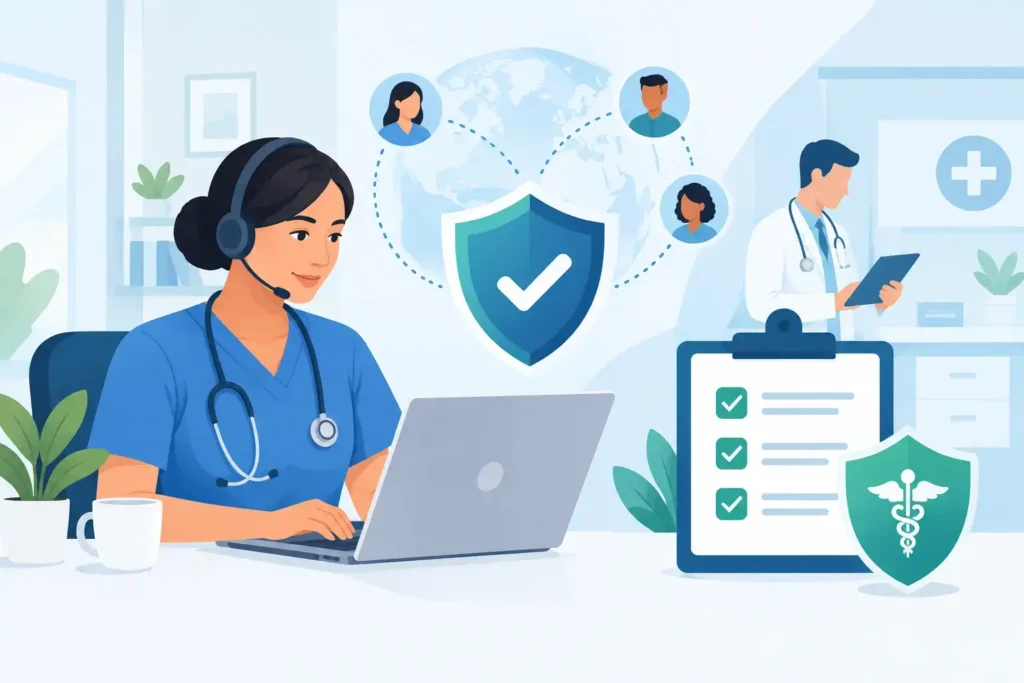
Are Remote Staff Compliant in Healthcare?
A remote medical receptionist confirming appointments from offshore can be compliant. A local administrator sharing a patient list through a personal email account may not be. When practice owners ask, “are remote staff compliant?”, the answer is not determined by where the person sits. It is determined by the safeguards, training, access and oversight around the work.
For allied health practices, NDIS providers and community care organisations, remote staffing can reduce admin pressure and staffing costs without lowering the standard of privacy or patient care. But it must be designed as part of your operating model, not treated as a quick fix for an overflowing inbox.
Are remote staff compliant when handling health information?
They can be. Remote staff can perform many administrative functions within a compliant healthcare environment, including appointment scheduling, referrals, patient follow-up, inbox management, billing support, document preparation, provider credential tracking and NDIS administration.
The central obligation remains with the Australian healthcare business. Whether a team member works in your clinic, from home in Australia or from an offshore delivery location, your practice must ensure personal and sensitive information is handled appropriately. This includes meeting applicable privacy obligations, contractual requirements, professional standards and, where relevant, NDIS quality and safeguarding expectations.
Health information deserves a higher level of care than ordinary business data. A patient’s contact details, treatment history, referral, Medicare information, plan details or progress notes should only be accessed when it is necessary for a clearly defined task. Compliance starts with that principle and carries through every system, process and conversation.
Location can introduce additional considerations, particularly around overseas disclosure and third-party access. It does not automatically make a staffing arrangement non-compliant. It does mean the practice needs documented controls that show who can access data, why they need it, how that access is secured and what happens if an issue occurs.
Compliance is a system, not a staff location
The most reliable remote teams operate inside the same controlled workflow as your local employees. They do not work from personal devices, use unapproved messaging apps or create their own process for handling patient information.
A compliant staffing model sets clear rules before the first shift. It identifies which tasks can be delegated, what systems are approved, what information is necessary for each role and who is accountable for checking quality. That structure protects patients while making it easier for managers to see exactly how work is being completed.
Role-based access limits unnecessary exposure
A virtual assistant responsible for appointment reminders does not necessarily need access to clinical notes. A billing support team member may need limited access to invoices and claiming systems, but not every patient record. Role-based access applies the principle of least privilege: staff receive only the permissions needed to complete their assigned duties.
This reduces risk and improves operational clarity. It also makes onboarding faster, because every role has a defined system profile rather than a collection of ad hoc passwords and shared logins.
Individual user accounts matter. Shared credentials make it difficult to trace changes, investigate errors or remove access promptly when someone changes roles. Each remote team member should use a unique account, strong authentication and approved systems that your business can monitor.
Secure technology supports accountable work
A compliant remote setup should include managed devices or tightly controlled workstations, secure internet connections, multi-factor authentication and restricted download, printing and copy-and-paste permissions where appropriate. The right controls depend on the work being performed and the systems your practice uses.
For some teams, a locked-down virtual desktop is the most practical option because patient data remains within the managed environment. For lower-risk work, such as public-facing marketing administration, the requirements may be different. The point is to match controls to risk rather than applying the same access level to every task.
Practices should also be clear about where communication occurs. Patient requests, referral updates and schedule changes should be handled through approved practice channels, not personal email, private messaging accounts or unsecured spreadsheets.
Training must be healthcare-specific
Generic offshore admin training is not enough for healthcare. A staff member may be excellent at customer service but still need targeted instruction on patient confidentiality, consent, identity verification, escalation protocols, clinical boundaries and the language used in Australian healthcare settings.
Training should cover realistic scenarios. What should a receptionist do when a parent asks for details about an adult child’s appointment? How should an NDIS assistant handle a request for plan information from an unauthorised person? When should a distressed caller be escalated immediately to a clinician or practice manager?
These are operational decisions with privacy and safety consequences. Staff need written scripts, clear escalation pathways and regular refreshers, not a one-off induction module.
What practice owners need to put in place
Before engaging remote staff, map the workflow rather than simply handing over your most time-consuming tasks. Start by separating work that is administrative from work requiring clinical judgement. Remote staff can support clinicians effectively, but they should never be asked to provide advice, interpret clinical information or make decisions outside their role and training.
A practical implementation plan should cover four areas:
- Task boundaries: Define what the remote role can do, what it cannot do and when it must escalate to a clinician or manager.
- System access: Set permissions by role, use individual logins and remove access immediately when duties change or employment ends.
- Privacy and security: Require confidentiality agreements, approved devices and communication channels, security training and an incident response process.
- Quality assurance: Review calls, correspondence, booking accuracy, documentation quality and access activity on a scheduled basis.
Your agreements with a staffing provider should also be specific. They should address confidentiality, data handling, subcontracting, security obligations, reporting of suspected incidents and return or deletion of data when the engagement ends. Vague assurances are not a compliance plan.
For NDIS providers, it is also sensible to consider how a remote team member supports your broader obligations around participant privacy, respectful communication, record keeping and incident escalation. A virtual assistant may not deliver direct supports, but the quality of their administration can still affect participant experience and organisational risk.
Where remote staffing can go wrong
Most compliance failures are caused by weak process, not by remote work itself. A practice may grant broad access because it is convenient, skip training because the role is “only admin”, or rely on informal instructions that change from person to person.
Another common issue is treating an offshore team member as separate from the practice. If they answer patient calls, manage appointments and update records, they are part of your service delivery experience. They need the same operational discipline, supervision and performance feedback as any onshore team member.
There is a trade-off to manage. Tighter security settings can add a few seconds to logins or require additional approval steps. For a healthcare business, that small amount of friction is usually worthwhile when it prevents unauthorised access, protects trust and gives managers an audit trail.
Choosing a healthcare-trained remote staffing partner
A general virtual assistant provider may be suitable for simple, non-sensitive tasks. Healthcare administration is different. The provider should understand Australian patient workflows, appointment types, referral processes, billing terminology, documentation standards and the limits of non-clinical roles.
Ask how staff are screened and trained, how access is controlled, whether performance is visible, and who supports the team after placement. You should also understand how incidents are reported and how quickly access can be changed if a risk is identified.
HealthDoers places pre-vetted, healthcare-trained remote staff into Australian healthcare workflows with structured onboarding, compliance monitoring and live visibility of shifts and performance. That level of operational control helps practices scale administrative capacity while retaining oversight.
Remote staffing is not a shortcut around compliance. Done properly, it is a more disciplined way to organise administrative work: defined roles, controlled access, documented processes and measurable accountability. The right question is not whether a staff member is remote, but whether your practice has built a safe and well-managed environment for them to succeed.
You might also like
-
Uncategorized

Best Remote Reception Tasks for Healthcare Teams
See the best remote reception tasks for Australian healthcare practices to cut admin pressure, protect patient experience and create more clinical capacity
-
Uncategorized

How to Streamline Referral Processing in Healthcare
Learn how to streamline referral processing in allied health and NDIS services, cut admin delays, protect privacy and give clinicians more patient…
-
Uncategorized

Patient Communication Standards Guide for Practices
Use this patient communication standards guide to improve access, protect privacy, reduce missed appointments and give patients a consistent experience.